
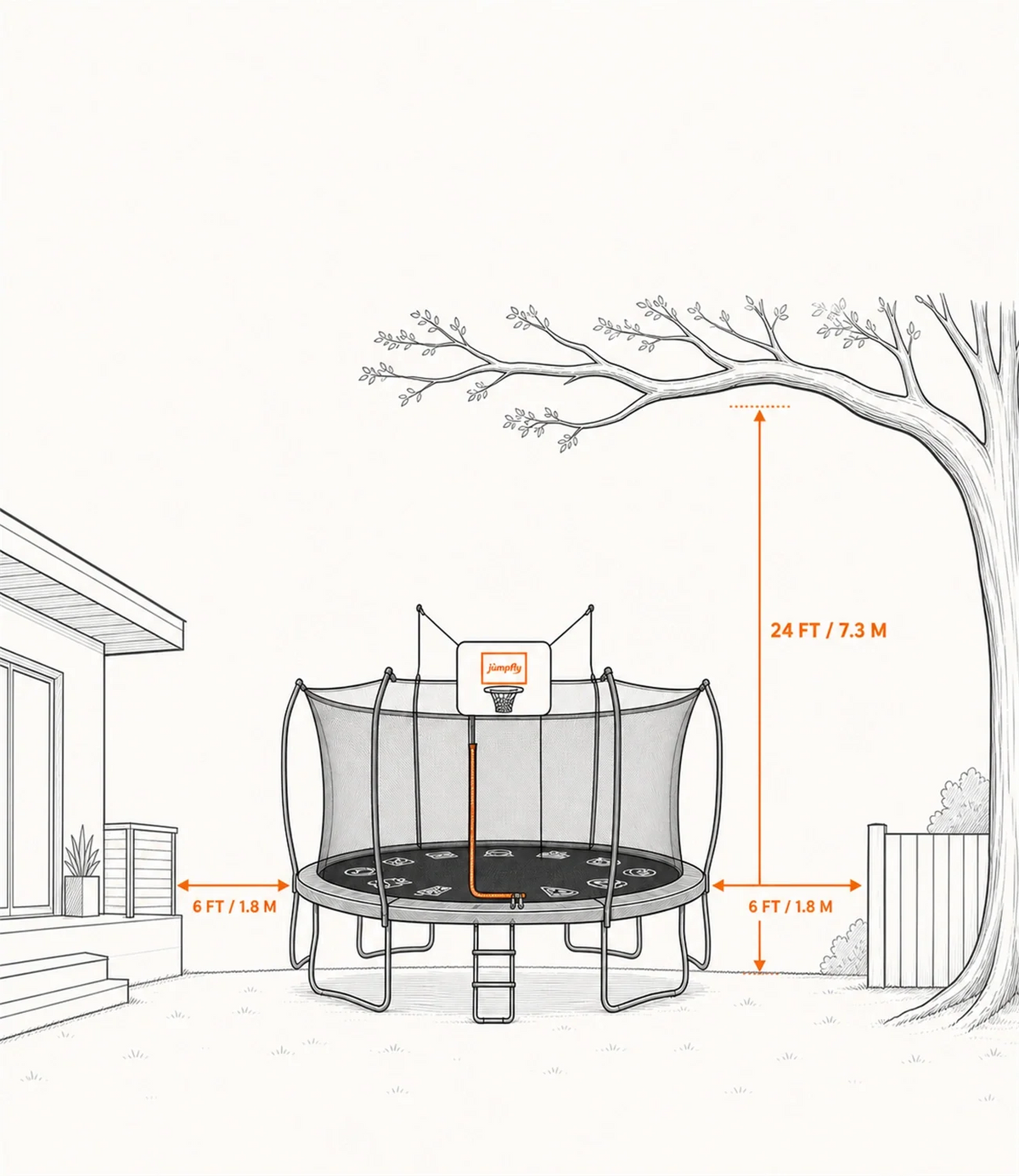
A trampoline can look like it fits until you account for the room children need around it—and the clear space above it. Use this guide to plan the yard before you choose a size.
Start with clear space
Your trampoline diameter is only the starting point.
When planning a backyard trampoline, measure the full usable area—not just the frame. Keep the jumping area away from fences, walls, patio furniture, trees and other obstacles, and make sure there is clear space overhead.
That means a 12FT trampoline needs about a 24FT clear area across: 12FT for the frame plus 6FT on each side. Do not count a narrow strip beside a fence or wall as usable clearance.
Look up before ordering. Low branches, rooflines, wires and hanging fixtures can make an otherwise roomy yard a poor trampoline location.

Planning illustration. Always follow the instructions supplied with your exact trampoline model and applicable local requirements.
Quick planning chart
How much yard space does each trampoline size need?
Use these as approximate clear-area measurements when you plan for a 6FT open perimeter on every side. Measure the actual product footprint and enclosure details on the product page before ordering.
| Trampoline size | Frame diameter | Approx. clear area across | Good starting point for |
|---|---|---|---|
| 10FT | 10 FT | 22 FT | More compact backyards |
| 12FT | 12 FT | 24 FT | Many family backyards |
| 14FT | 14 FT | 26 FT | Families wanting more room to play |
| 15FT | 15 FT | 27 FT | Larger, open yards |
| 16FT | 16 FT | 28 FT | Extra-large, open yards |
Approximate clear area = frame diameter + 12 FT. It is a space-planning tool, not a substitute for the installation manual.
Choose the spot, not just the size
Four checks before you mark the ground.
Keep distance from hard edges
Do not place the frame close to a fence, wall, deck edge, patio set or play structure. A clear perimeter gives children more room if they leave the mat.
Look above, not only around
Tree branches, roofs and overhead wires are easy to miss when you measure at ground level. Check the full height of the space.
Choose level, well-draining ground
A flat lawn that does not collect water is easier to set up and maintain. Avoid slopes, dips and places that stay muddy after rain.
Leave access to your home
Make sure the planned circle does not block a gate, a path, a grill area or the way you normally use your backyard.
A three-step yard test
Measure it before you buy it.
Find the usable area
Measure the level, open part of your yard—not the total yard size shown on a listing or property plan.
Mark the full circle
Use a tape measure and garden hose, rope or chalk to mark the frame size plus the open perimeter around it.
Walk it and look up
Walk around the marked area, then check above for branches, rooflines, wires and anything that could interfere.
Common questions
Backyard trampoline space FAQ
Does a 12FT trampoline only need a 12FT area?
No. The 12FT measurement describes the frame diameter. Plan an open perimeter around the trampoline as well, so the total area is larger than the frame itself.
Can I put a trampoline next to a fence?
It is better to choose an open location. A fence, wall or other hard object reduces the safety perimeter and can make entry, maintenance and supervision less convenient.
Can I put a trampoline under a tree?
Only if there is adequate clear height and no branches, fruit, debris or other overhead hazards. Check the space above the enclosure, not only the space above the jumping mat.
What if my yard is between two trampoline sizes?
Choose the size that leaves a more comfortable clear perimeter. If the larger frame makes the usable open area feel tight, the smaller size is usually the better fit for the yard.
Do I still need to check the product manual?
Yes. This guide helps you plan your backyard. Your exact JumpFly model's assembly instructions and safety information are the final source for installation requirements.
For general trampoline safety guidance, see the U.S. Consumer Product Safety Commission.
Ready to choose a trampoline size?
Compare 10FT–16FT options, then return here to confirm the full backyard footprint before you order.



Leave a comment
All comments are moderated before being published.
This site is protected by hCaptcha and the hCaptcha Privacy Policy and Terms of Service apply.